Ikon Training
The NHS Post-Incident Support Framework: Why supporting people after an incident is part of preventing the next one
August 14th, 2026
9 mins
August 14th, 2026
9 mins
Guidance is updated all the time. Some documents refine existing practice. Others tell us something about the direction healthcare is moving in.
For me, the recently published NHS Post-Incident Support Framework falls firmly into the second category.
At first glance, it looks like guidance about what organisations should do after an incident of violence or aggression. But the more I read it, the more I found myself thinking that it isn’t just about post-incident support. It’s about something much bigger.
It’s about recognising that the way organisations support people after an incident shapes far more than recovery.
It influences confidence. It affects whether people feel able to report future incidents. It determines what organisations learn, and ultimately how effectively similar situations are prevented. That feels like an important shift.
For a long time, conversations around workplace violence have understandably focused on the incident itself. How do we keep people safe? How do we respond effectively? How do we restore order?
Those questions remain just as important today. Prevention will always be the priority… but what this framework adds is another question:
It feels the answer is yes.
NHS England’s recently published Post-Incident Support Framework reflects that way of thinking. Rather than treating support, organisational learning and violence prevention as separate activities, it brings them together as part of the same conversation. If you’d like to explore the guidance alongside this commentary, you can read the official NHS webpage and download the full framework before continuing here.
One of the things I found particularly encouraging is that the framework doesn’t present post-incident support as a single conversation or a one-off intervention. Instead, it recognises that people recover differently, organisations learn over time and creating safer workplaces depends on more than responding well in the moment.
In many ways, it’s encouraging to see the same ideas we align with reflected so clearly.
When we talk about violence prevention, it’s easy to think only about what happens before an incident. Violence prevention also means creating environments where people feel supported, organisations learn from experience and every incident strengthens future practice.
That’s why I don’t see this framework as simply new guidance for the NHS; I see it as a reflection of a broader change in how organisations are thinking about workplace safety.
Increasingly, organisations are recognising that success isn’t measured solely by how effectively an incident is managed. It’s also measured by how well people are supported afterwards, what lessons are learned and what changes as a result.
Because when those things happen consistently, post-incident support stops being something that follows prevention. It becomes part of it.

When an incident comes to an end, it’s natural to feel a sense of relief. The behaviour has stopped, the immediate risk has been managed, and attention turns to getting people back to work as quickly as possible.
However, one of the most overlooked moments often begins at exactly that point.
In my experience, organisations rarely underestimate the importance of responding safely during an incident. Where challenges can arise is in what happens afterwards. Once the immediate pressure has passed, it’s easy to assume recovery will happen naturally.
The framework challenges that way of thinking.
It recognises that managing the incident is only the first stage of the response. What follows (the conversations, the reassurance, the opportunity to reflect and the support offered over the days and weeks afterwards) can have just as much influence on how confident someone feels returning to work as the way the incident itself was managed.
I think that’s one of the framework’s strongest messages.
Supporting people after an incident isn’t a single conversation. It’s a process. Rather than viewing post-incident support as a single event, the framework breaks it into four distinct stages, each designed to meet different needs at different points in someone’s recovery.
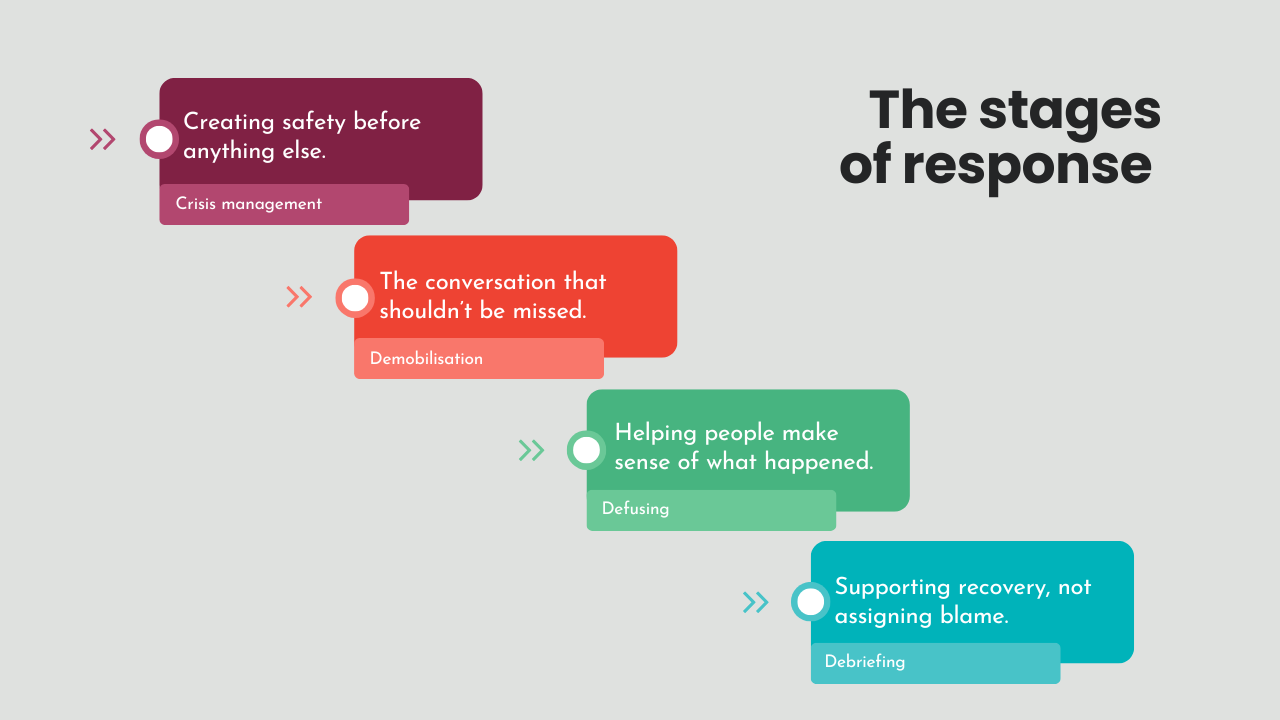
Immediately following an incident, the priority is exactly what we’d expect: restoring safety.
That means making sure everyone is protected from further harm, ensuring any medical needs are addressed and stabilising the situation before anything else happens. It can be tempting to move quickly into reviewing what happened, particularly after a significant incident.
But in those first moments, people rarely need analysis. They need to know they’re safe. T They need reassurance. They need clarity.
Once the immediate risk has passed, the framework introduces something I think many organisations will recognise, even if they don’t always describe it this way.
Demobilisation is the first opportunity to pause.
Not to investigate. Not to analyse. Simply to check in with the people involved.
Over the years, I’ve found is that managers often worry about saying the wrong thing after a difficult incident. In reality, people are rarely expecting perfect answers. More often, they’re looking for acknowledgement, reassurance and a clear understanding of what happens next. Those early conversations can have a much greater impact than we sometimes realise.
As the immediate pressure begins to ease, people often start processing what they’ve experienced. It’s not necessarily about assigning blame or establishing every detail, but rather creating space for people to talk openly, ask questions and begin making sense of what happened in a supportive environment.
I’ve rarely found that people need someone to immediately solve every concern. More often than not they need someone prepared to listen without judgement.
That’s an important distinction, and it’s one the framework recognises well.
Perhaps one of the clearest distinctions the framework makes is the balance between supporting recovery and investigating the incident.
Debriefing isn’t designed to determine fault or identify organisational improvements. Its purpose is to support the people involved, helping them understand their experience and identifying whether any additional support may be needed.
That separation matters.
When organisations try to combine emotional recovery with operational review, there’s a risk that neither is given the attention it deserves. Supporting people and improving systems are both essential. They just don’t need to happen in the same conversation.
The framework places considerable emphasis on what happens in the minutes and hours after an incident. At first glance, those conversations can feel like another step in the process. Read a little more closely, however, and they become something much more significant. They’re often the point at which recovery begins.
I think it’s easy to underestimate the influence those first conversations can have. Quite understandably, organisations focus on making sure people are physically safe, but emotional recovery doesn’t always follow as quickly. Long before someone is referred for additional support, they’re already forming an impression of how their organisation is responding.
Those questions are often answered long before anyone speaks to Occupational Health or accesses formal support.
That’s one of the reasons the framework places such importance on demobilisation and defusing. They’re not simply stages to work through. They create space for people to feel heard, understand the support available and begin making sense of what has happened.
If I’ve learned anything from working alongside healthcare organisations, it’s that managers shouldn’t place unnecessary pressure on themselves during these moments. It’s easy to worry about saying the wrong thing or not having the right answers, when in reality people rarely expect perfect words.
More often, they’re looking for reassurance that what they’ve experienced has been recognised, that they’re being supported and that they won’t be left to deal with it alone. That doesn’t require someone to become a counsellor overnight – it requires empathy, curiosity and the confidence to have a genuine conversation.
Perhaps this is one of the most practical messages within the framework: Post-incident support doesn’t begin with a referral. It begins with people.
The national guidance has highlighted three key considerations, so we created a printable one-pager to share across your organisation.
Learning should never take place of someone’s recovery
The framework draws a clear line between supporting the people involved in an incident and learning from the incident itself. At first, that might seem like a subtle difference, but I don’t think it is.
Too often, organisations naturally want to move quickly into understanding what happened. They want to establish the facts, identify lessons and reduce the chances of a similar incident happening again. All of those are all important objectives.
The challenge is that immediately after an incident, the people involved are often asking themselves a very different question,
“Am I okay?”
The framework reminds us that organisations should answer that question before asking people to analyse what happened. That’s an important principle, not just for healthcare but for any organisation supporting people who regularly experience conflict, aggression or violence.
When people feel supported first, they’re more likely to engage openly in the conversations that follow… because they have the space to reflect honestly, contribute to organisational learning and help identify meaningful improvements.
Recovery isn’t an obstacle to learning. It’s what makes better learning possible.
One misconception I occasionally come across is the idea that supporting someone and reviewing an incident are simply two parts of the same conversation. Whereas in practice, they serve very different purposes.
Supporting someone is about recognising the impact an incident may have had on them. It’s about giving them time, listening without judgement and helping them access further support if they need it.
That conversation shouldn’t be driven by organisational objectives. It should be driven by the individual’s needs. And when organisations get that balance right, something interesting happens.
People often feel more confident contributing to future reflection and reporting because they know they weren’t treated simply as a source of information. They were treated as people first.
Supporting people first doesn’t make organisational learning any less important. If anything, it makes it more meaningful.
Once people have been appropriately supported, organisations have an opportunity to step back and ask a different set of questions:
These conversations are no longer centred on the individual, but the system around them. That’s why I think the framework’s distinction between debriefing and an After Action Review is so valuable. It reminds us that supporting people and strengthening organisations are complementary activities, but they don’t need to happen at the same time. Doing one enables the other to happen. And if organisations are committed to building confidence over the long term, that distinction really matters.
The title of this framework is ‘Post-Incident Support Framework’.
Yet the more time I spent reading it, the more I found myself thinking that much of it is actually about preventing the next incident. That isn’t a contradiction… and in many ways, it’s the framework’s biggest strength.
For years, organisations have understandably measured success by how effectively they respond when something goes wrong. Increasingly, I think the more important question is:
What changes because it happened?
Every incident leaves behind valuable insight.
Not just about the incident itself, but about the environments and behaviours that shaped it. Sometimes it’s recognising missed opportunities to de-escalate. Sometimes it’s identifying where staff need additional confidence or support. Sometimes it’s something much simpler that nobody had noticed before.
Those lessons only become valuable if organisations choose to act on them. That’s why I don’t think prevention begins and ends before an incident occurs. Some of the most important prevention work happens afterwards.
It’s found in the conversations teams have, the improvements they make, the confidence they build and the small changes that make tomorrow safer than today.
It’s a principle we’ve believed in for a long time at IKON. Responding well to incidents will always matter, but the greatest opportunity often lies in reducing the likelihood of the same challenges happening again.
We’ve explored that idea in more detail in our article, Why prevention will always cost less than intervention, which looks at why organisations that invest in learning, reflection and early intervention are often better placed to create safer workplaces over the long term.
If there’s one area where I think organisations have an opportunity to change the conversation, it’s around reporting. For many people, reporting has become associated with paperwork.
It’s the form that needs completing before the end of a shift. It can feel like another administrative task, or something that’s required because policy says so.
The framework encourages us to see reporting very differently.
It positions reporting as the point where post-incident support begins, not where the incident ends. Staff are encouraged to report all incidents of violence and aggression so organisations can provide timely support, check on wellbeing and put learning in place to reduce the likelihood of recurrence. It also highlights the importance of consistent reporting processes, manager follow-up and creating a culture where people feel confident speaking up.
I think that’s an important shift in thinking. Because without a report, an organisation may never know someone needs support. Patterns of violence or aggression can remain hidden, and opportunities to reduce future risk can easily be missed.
In other words, reporting isn’t simply about recording what happened – it’s about creating the opportunity to respond well.
The framework also acknowledges something many organisations will recognise. People don’t always avoid reporting because they don’t care. Sometimes they worry nothing will change. Sometimes they don’t have time. Sometimes they simply don’t believe the process will make a difference. That’s why the guidance places so much emphasis on timely follow-up, visible leadership and ensuring staff receive meaningful support throughout the reporting process.
I’ve often found that organisations with the strongest reporting cultures aren’t necessarily the ones with the highest number of incident forms. They’re the ones where people believe reporting leads to a conversation, meaningful support, organisational learning and, ultimately, action.
The quality of a reporting culture isn’t measured by how many forms are completed. It’s measured by what happens because someone chose to report.

Looking beyond the individual recommendations, I think this framework tells us something about where healthcare is heading. It would be easy to see it as new guidance. I see it more as a reflection of a wider change that’s already underway.
Over the last few years, conversations around workplace violence have become much broader. They’re no longer focused solely on how organisations respond in the moment. Increasingly, they’re asking questions such as:
That’s what I think this framework does particularly well. Throughout the guidance, themes such as psychological safety, manager capability, leadership responsibility, organisational learning, continuous review and staff wellbeing are treated as connected rather than separate initiatives. Many of these ideas aren’t new. They’re principles we’ve believed in for a long time. What’s encouraging is seeing them brought together within national guidance in a way that’s practical, coherent and clearly connected.
It’s also why we’ve continued to develop the IKON Academy. We’ve never seen learning as something that ends when a course finishes. Giving people opportunities to revisit key concepts, reflect on real experiences and reinforce good practice over time helps turn individual learning into lasting organisational capability.
Perhaps that’s the biggest shift this framework represents. It reminds us that workplace safety isn’t built through one intervention or one policy. It’s built through the way organisations prepare people, support them, learn from experience and keep improving over time.
Every organisation will read this framework from a different starting point.
Some will already have well-established post-incident support processes and may see much of their current approach reflected in the guidance.
Others may identify opportunities to strengthen manager confidence, improve reporting processes or create more structured opportunities for organisational learning.
It isn’t asking organisations to reach a finish line. It’s encouraging them to keep improving.
Throughout the document, there’s a clear emphasis on regular review, leadership commitment, staff engagement and continuous evaluation. The intention isn’t simply compliance. It’s ensuring post-incident support continues to evolve alongside the needs of the workforce and the organisation.
If there’s one question I’d encourage leaders to reflect on after reading this framework, it isn’t:
“Have we implemented every recommendation?”
It’s something much simpler.
“How well are we supporting our people once an incident is over?”
Because the answer to that question influences far more than recovery.
That’s why I think the significance of this framework extends beyond the NHS. It reminds us that creating safer workplaces isn’t only about preparing people for difficult situations. It’s also about how organisations respond afterwards, how they support their people and what they choose to learn.
Perhaps that’s the framework’s biggest message. Prevention isn’t separate from what happens after an incident. In many ways, it’s strengthened by it.
Stay connected
Every incident has the potential to strengthen future practice.
If you’re interested in the changing conversations around workplace safety, violence prevention and supporting people after incidents, follow IKON Training on LinkedIn for practical insights, industry updates and expert perspectives.
Or get in touch to explore how we could support you or your team more directly.
Keep up to date with industry insights, sign up to the IKON Newsletter: