Ikon Training
New government guidance on restrictive intervention in schools: What education leaders must know from April 2026
April 28th, 2026
4 mins
April 28th, 2026
4 mins

From April 2026, new government guidance on restrictive interventions and the use of reasonable force in schools came into effect in England.
For many schools, this is more than a policy update. It represents a shift in how behavioural incidents are understood, recorded and managed, with greater expectations placed on leadership, safeguarding oversight and staff preparation.
While teachers and support staff are often the people responding in the moment, the guidance reinforces that school leaders and governing bodies carry responsibility for ensuring staff are equipped to act safely, lawfully and confidently.
Importantly, this direction of travel is not unique to England. Similar frameworks around restrictive intervention have already been introduced in Scotland, reflecting a broader shift across UK education systems towards prevention, transparency and safeguarding.
For education leaders, the question is no longer simply “when can force be used?”
It is increasingly “How can schools reduce the need for it in the first place?”
The updated guidance has been introduced to provide clearer expectations around safeguarding, transparency and the safe use of restrictive interventions in schools. It reflects growing awareness that behaviour incidents must be managed consistently, safely and with greater oversight.
Across the education sector, staff are supporting pupils who may be experiencing:
When behaviour escalates, staff are often required to make rapid decisions under pressure. In these moments, clarity matters.
The new guidance aims to provide that clarity by:
The Department for Education is reinforcing that schools must have clear and strong policies. The message behind policy is clear:
Restrictive intervention should always be a last resort, not a routine response.
The updated guidance introduces several important expectations for schools and leadership teams.
The guidance provides clearer explanations of terms such as:
This helps remove uncertainty around what constitutes an intervention and when it may be appropriate.
Schools are expected to ensure incidents involving restrictive intervention are clearly recorded and communicated appropriately. All staff must be competent to do so. This is to support safeguarding transparency, accountability and organisational learning after incidents.
To reinforce that safe responses are organisational responsibilities, and not individual decisions, school leaders and governing bodies are expected to ensure:
Perhaps the most important shift is cultural.
The guidance repeatedly emphasises the importance of preventing escalation wherever possible, rather than focusing solely on how staff should respond once behaviour becomes dangerous.
This is where staff confidence, communication and early intervention skills become critical.
Although the topic of restrictive intervention often focuses on teachers, the reality is that behaviour incidents can involve many roles within a school environment.
The guidance therefore applies to a wide range of staff, including:
Each of these roles may encounter situations where behaviour escalates and quick decisions are required.
While staff respond in the moment, school leaders remain responsible for ensuring staff are appropriately trained and supported.
Ensuring staff understand the following is now an essential part of safe school leadership:
One of the key principles behind the updated guidance is recognising that dangerous behaviour rarely begins suddenly.
In most situations, escalation develops gradually.
Understanding how escalation unfolds can help staff respond earlier and reduce the likelihood of situations reaching crisis.
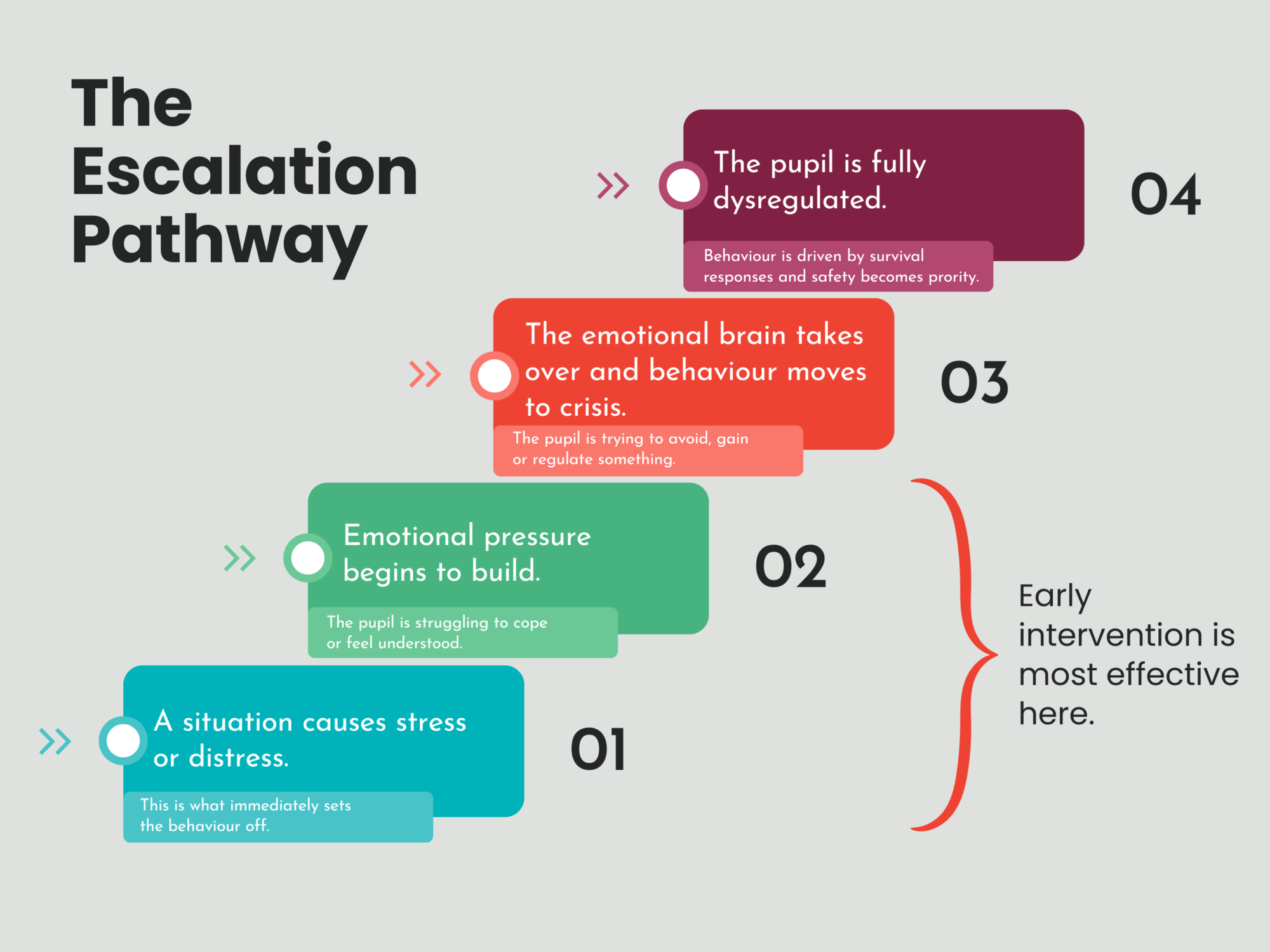
Typical escalation stages may include:
A situation can cause stress or emotional pressure for a pupil.
Example: Difficulty understanding work.
Staff response: Provide calm reassurance, clarify expectations or offer support before frustration develops.
Early behavioural signals begin to appear.
Example: Refusal to engage with a task or visible agitation.
Staff response: Acknowledge the frustration calmly and offer support and alternative ways to re-engage.
Behaviour becomes more confrontational or disruptive.
Example: Raised voice, challenging instructions or increased agitation.
Staff response: Focus on de-escalation by using calm language, reducing pressure and involving additional staff if necessary.
The situation has escalated to a point where there is an immediate risk of harm to a pupil, staff or others.
Example: Student begins pushing furniture and throwing objects in the classroom.
Staff response: Prioritise safety for everyone involved. Restrictive intervention may only be used where lawful, proportionate and necessary to prevent harm.
Understanding these stages helps staff recognise the earliest opportunities to intervene.
When staff feel confident responding early, situations are far less likely to escalate to crisis, which reinforces the principle of the new guidance:
Restrictive intervention should always be a last resort.
The emphasis on prevention within the new guidance reflects a wider shift across many sectors: recognising that most incidents can be prevented when escalation is recognised early.
Early intervention focuses on responding during the frustration stage, when behaviour is still manageable and communication remains effective.
This might include:
When staff feel confident recognising these moments, they are far more likely to reduce the likelihood of situations escalating further. We explored the wider role of early intervention in organisational culture in our recent Insights article, Early Intervention as a Workplace Culture. The same principle applies in schools:
The earlier staff feel confident responding, the safer the environment becomes for everyone.
Education staff regularly manage complex situations while maintaining learning environments for entire classrooms.
This requires not only patience and professionalism, but also confidence under pressure.
Without clear guidance or shared approaches, staff may feel uncertain about:
The purpose of the new guidance is not to place blame on staff. It is to support schools in ensuring staff feel prepared, supported and confident.
Applying force is never black and white. It is, however, always a lost resort. Staff should all have the same idea of when they can use reasonable force and seclusion, and the procedures to record and report incidents.
When teams share a consistent approach to behaviour management, they are better able to:

At IKON Training, we work alongside education teams to help staff build the confidence and practical skills needed to manage challenging behaviour safely.
Our approach focuses on helping staff recognise early behavioural signals, apply effective de-escalation strategies, and understand when intervention must remain lawful and proportionate. Just as importantly, it supports teams to respond consistently and reflect on incidents in a way that strengthens future practice.
By focusing on early intervention, communication and situational awareness, schools can significantly reduce the likelihood of behaviour escalating to crisis.
Many schools are already strengthening their approach through training programmes catered for their education environments. These programmes help teams develop shared understanding and practical confidence, creating school environments where staff feel prepared to respond early and safely.
With the new guidance now in effect, now is the right time for education leaders to review how their organisations prepare staff for challenging situations. Schools may wish to consider:
It is ensuring that staff feel confident recognising escalation early and responding safely.
When staff feel prepared, situations are less likely to escalate, pupils feel safer, and school environments become more supportive for everyone.
If you or your team have any questions about the new legislation, please don’t hesitate to get in touch with us.
Keep an eye on our social media for more tools, case studies, webinars, and resources designed to support clear, confident, safe communication at work.
Follow us on LinkedIn: IKON Training
Or drop us a message to explore how we could support your team more directly.
Find out more about our online courses.
Keep up to date with industry insights, sign up to the IKON Newsletter: